God Photos: Photos

Pages

Showing posts with label Photos. Show all posts

Monday, April 3, 2017

Unknown Facts About Lord Rama


Ramnavami is one of the most important festivals of the Hindus, particularly for the Vaishnava sect of the Hindus. On this auspicious day, devotees repeat the name of Rama with every breath and vow to lead a righteous life. People pray to attain the final beatitude of life through intense devotion towards Rama and invoke him for his blessings and protection.

Who Is Lord Rama

Rama (or Ramacandra) is the seventh avatar of the Hindu God Vishnu. Rama’s father is King Dasaratha, a prince of the solar race, and his mother is Queen Kausalya. Rama was born at the end of the Second Age or Treta-yuga and he came into the world specifically at the bidding of the gods to deal with the fearsome multi-headed demon Ravana, the king of Lanka (modern Sri Lanka). The great god Vishnu answered the gods’ call and appeared in a sacrificial fire made by Dasaratha.

Janaka the king of Videha hosted our hero, and he met the king’s beautiful daughter Sita (also called Janaki or Maithili). The king had promised the princess in marriage to anyone who could manage to bend a huge bow which had once been the weapon of the Great God Shiva. Rama, with his divine strength, did more than just bend the bow but broke it in half and so won the hand of Sita, his first and most revered wife.

Rama’s succession to the throne of Ayodhya was made difficult by his mother’s hunchback slave Manthara. Jealous of Rama, she soured the opinion of Kaikeyi, Dasaratha’s second wife, and convinced her to persuade her husband to instead make Bharata heir to the throne. On top of this slight Rama was exiled from the kingdom for fourteen years. So, accompanied by Sita and his ever faithful companion Laksmana, Rama went to live in the far south in Citrakuta, deep in the Dandaka forest.

In Ayodhya, the birthplace of Sri Rama, a big fair is held on this day. In the south of India, the "Sri Ramnavami Utsavam" is celebrated for nine days with great fervor and devotion.

Facts About Lord Rama

1)Ramayana has been written by Maharshi Valmiki. The time when King Dashrath had organized a yagya for the birth of Lord Rama, his age was 60 years.

2)Rama is the 7th incarnation of the God Vishnu, and next to Lord Krishna, he is considered to be his most important avatar

3)Lord Rama’s name comes in at the 394th place of the Vishnu Sahasranama, which is a compilation of the thousand names of Lord Vishnu.


4)For the sake of honoring his father, Rama accepted 14 years in exile with his wife Sita and brother Lakshmana.

5)Rama is considered to be the ideal man and a perfect human; not only physically, but mentally and spiritually.

6)When Lord Rama went to exile he was 27 years old.

7)When King Dashrath asked Lord Rama to go to a forest, he wanted to give him lots of wealth so that he remains happy there. However, his third wife Kaikayi didn’t allow for the same.


8)Rama’s principle devotee was Hanuman, a symbol of devotion and right action.

9)The entire tale of the Ramayana is Rama’s journey to take back his wife that was stolen by the evil king Ravana, lord of Lanka. It’s widely believed that Rama (Vishnu) and Sita (an incarnation of Lakshmi) have one of the oldest and famous love stories of all time.


10)Lord Rama took Jal Samadhi in the Sarayu River and consequently left the earth forever.

11)Lord Rama prophesied that Vaali would kill him in his next birth and thus take his revenge. Vaali was reborn as a hunter and was the one that caused the death of Lord Krishna.


12)It is believed that Lakshman did not sleep for the entire period of the exile of 14 years in order to protect his brother and sister- in-law. Because of this he is called Gudakesh. When the goddess of sleep appeared before him at the first night of the their exile to the forests and when Rama and Sita were asleep, Lakshman requested the goddess to give him no sleep for the entire 14 years, so that he can be awake to protect his beloved brother and Sita. The goddess was impressed by this and granted the boon on a condition that someone else has to bear his sleep. On Lakshman request the goddess visited his wife Urmila, sister of Sita. Urmila agreed to share her husband loss of sleep, and thus slept for entire 14 years. Hence the reason she is not much in the story, but a strong reason for helping Laksman to kill Ravana son Meghnadh in the war against to Ravana as Meghnadh could be killed only by a man who have not slept for 14 years.

13)The victory of Rama over Ravana is celebrated in a 10 day festival known as Dussehra, and his return to his kingdom and coronation is celebrated with Diwali, the festival of lights.

I hope you like Facts About Lord Rama Post. Share with your family and friends. Keep visiting for latest updated posts. Any Suggest? comment below.

Life Changing Quotes BY Lord Rama

Saturday, February 4, 2017

Beautiful Lord Ambarnath Wallpapers


Story Of Amarnath Cate Temple
Rig Veda refer Shiva as Rudra as in its following verse . "We Worship Tryambaka (Rudra) , Who spread Fragrance and Increases Nourishment , May He release me, like the cucumber from its stem, From Mortal Life, But not From Immorality. "(Rig Veda Mandal VII Sukta 59 and Mantra 12). The Yajurveda describes Lord Siva as ascetic warrior Whose robe is of Deer Skin and he carries Trishul. According to the verse Satyam, Shivam, Sundaram the life is described as having three facets TRUTH (Satyam), GOOD (Shivam) and the BEAUTIFUL (Sundaram).

Shiva is a living God. The most Sacred and ancient books of India, the Rig Veda narrates his presence in the hymns. Vedic myths, rituals and even astronomy testifies to His existence from the dawn of time. The Mohenjodaro and Harappa findings confirm Shiva worship in the ancient India.

According to the older scriptures, He has three places of his residence:
One is Kailash Parvat
Another is Lohit Giri (under which Brahamputra flows) and
Third is Muzwan Parvat.

The Amarnath Cave has special significance.
The Legend about the importance of Amarnath Cave is as follows :-
This is The Cave which was chosen by Bhole Shankar for narrating the secrets of immortality and creation of Universe to Maa Parvati ji. The story goes like this. Centuries ago Maa Parvati asked Shiv ji to let her know why and when he started wearing the beads of heads ( Mund Mala). Bhole Shankar replied when ever you are born I add one more head in my beads. Maa Parvati said, " My Lord, my body is destroyed every time and I die again and again, but you are Immortal. Please let me know the secret of this ." Bhole Shankar replied that it is due to Amar Katha ."

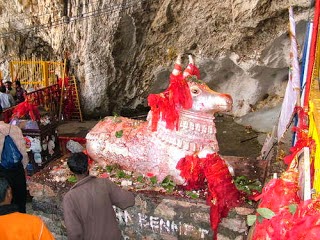
Maa Parvati insisted that she may be told that secret. For long Shiva ji continued postponing . Finally on consistent demand from Maa Parvati he made up his mind to tell the immortal secret . He started for lonely place where no living being could listen it. He choose Amarnath Cave. In preparation to that he left his Nandi ( The Bull which he used to ride ) at Pahalgam (Bail gaon). At Chandanwari he released Moon from his hairs (Jataon). At the banks of Lake Sheshnag he released the snakes. He decided to leave his son Ganesha at Mahagunas Parvat (Mahaganesh Hill). At Panchtarni, Shivji left the Five Elements behind (Earth ,Water, Air , Fire and Sky) which make living being. He is the Lord of these elements. It is believed that as a symbol of sacrificing the earthly world, Shivaji and Maa Parvati had Tandav Dance. After leaving behind all these, Bhole Shankar enters the Holy Amarnath Cave along with Parvati Maa. Lord Shiva takes his Samadhi on the Deer Skin and concentrate . To ensure that no living being is able to hear the Immortal Tale, He created Rudra named Kalagni and ordered him to spread fire to eliminate every living thing in and around the Holy Cave. After this he started narrating the secret of immortality to Maa Parvati. But as a matter of chance one egg which was lying beneath the Deer skin remained protected. It is believed to be non living and more over it was protected by Shiva -Parvati Asan (Bed). The pair of pigeons which were born out of this egg became immortal having listened the secret of immortality (Amar Katha). Many pilgrims report seeing the pair of pigeons when they trek the arduous route to pay their obeisance before the Ice-Lingam (the phallic symbol of Shiva).

Tuesday, December 6, 2016

Famouse Murudeshwara Statue, Karnataka


Murudeshwara temple, dedicated to Lord Shiva lies in the holy beach town in the Bhatkal Taluk of Uttara Kannada district in the state of Karnataka, India.

It is the second tallest statue of Shiva in the world. The statue is 123 feet (37 m) in height, and took about 2 years to build. The statue was built by Shivamogga's Kashinath and several other sculptors, financed by businessman and philanthropist Mr R.N. Shetty, at a cost of approximately 50 million rupees. The idol is designed such that it gets the sun light directly and thus appears sparkling.


Monday, June 13, 2016

Jwalamukhi Tripurasundari Temple Mysore


The ancient temple of Jwalamukhi Tripurasundari is built in Uthanahalli, Mysore at the foot of Chamundi Hills. She is believed to be the sister of Goddess Chamundeshwari, the presiding deity of Chamundi hills temple. Jwalamukhi Tripura Sundari temple is approximately 6 kilometers from the center of Mysore and is 3 kms from Chamundeshwari temple atop the hills. Jwalamukhi means a person with energy of fire and some believe that she represents the flaming mouth of Jalandhara, the demon whom Lord Shiva crushed to death using huge masses of mountains. Tripura Sundari means beauty of the three worlds.

The temple idol was installed during the rule of the Wodeyars. Now, a new courtyard is built all around the temple to protect it. Tourists and devotees throng the temple for darshan/blessings.

Friday, June 10, 2016

Umanand Temple , Guwahati


Lord Shiva is reported to have strewn the Vibhuthi, Holy Ashes here imparted Wisdom to Parvati and sat in meditation.
According to the Kalika Purana, in the beginning of the creation Siva sprinkled ashes (bhasma) at this place and imparted knowledge to Parvati (his consort). It is said that, when Siva was in meditation on this hillock, Kamadeva interrupted his yoga and was therefore burnt to ashes by the fire of Siva’s anger and hence the hillock got the name Bhasmacala.
This mountain is also called Bhasmakuta. The Kalika Purana states that Urvasikunda is situated here and here resides the goddess Urvasi who brings Amrit (nectar) for the enjoyment of Kamakhya and hence the island got the name Urvasi Island.
The presiding deity of the temple is Umananda (Tatrasti bhagavan sambhu- ruma- nandakarah Prabhu). It is believed that, worship here on the Amavasya day when it falls on Monday brings the highest bliss. The Siva Chaturdasi is the most colourful festival that is held here annually. Many devotees come to the temple on this occasion for the worship of the deity.

Arasuri Ammaji Temple Gujrat


Ambaji mata temple is a major Shakti Peeth of India. It is situated at a distance of approximately 65 kilometres from Palanpur, 45 kilometres from Mount Abu and 20 kilometres from Abu Road and 185 kilometres from Ahmedabad 50 kilometer from Kadiyadra near the Gujarat and Rajasthan border.
In the holy temple of “Arasuri Ambaji”, there is no image or statue of goddess the holy “Shree Visa Yantra” is worshiped as the main deity. No one can see the Yantra with naked eye. The photography of the Yantra is prohibited.
The original seat of Ambaji mata is on gabbar hilltop in the town. A large number of devotees visit the temple every year specially on Purnima days.
Arasuri Ammaji Temple Images

Wednesday, January 13, 2016

Famouse Shiva Statue Omkareshwar


Omkareshwar is a Hindu temple dedicated to God Shiva. It is one of the 12 revered Jyotirlinga shrines of Shiva. It is on an island called Mandhata or Shivapuri in the Narmada river; the shape of the island is said to be like the Hindu OM symbol. There are two temples here, one to Omkareshwar and one to Amareshwar But as per the sloka on dwadash jyotirligam, Mamleshwar is the jyotirling, which is on other side of Narmada river.